Reformation Sunday is a good time to remember that faith is not for the faint of heart. Martin Luther discovered that the hard way. He questioned the church, challenged its authority, and insisted that the good news of Jesus Christ was bigger than a system that had convinced people they needed to earn God’s love. It didn’t exactly make him the most popular guy in the room.
But Luther wasn’t trying to start a revolution just to shake things up. He believed the church needed to rediscover something essential: God’s grace is a gift, God’s love is freely given, and the gospel changes everything.
Our two Scripture readings for Reformation Sunday point us toward this same truth.
In Jeremiah 31:31-34, God promises a new covenant. Not simply another set of rules written on stone, but a relationship in which God’s law is written on people’s hearts. God promises forgiveness and a future in which people will know God—not because they have finally gotten everything right, but because God refuses to give up on them.
Then, in Matthew 22:34-40, Jesus is asked which commandment is the greatest. His answer? Love God with all your heart, soul, and mind, and love your neighbor as yourself.
That’s it. Love God. Love your neighbor. Simple enough to fit on a bumper sticker. Hard enough to occupy us for a lifetime.
Sometimes, Doing Hard Things Starts With Losing a Tooth
When Billy Green was five years old, he lost a tooth and proudly told his Sunday school teacher. The tooth fairy had rewarded him with $5 in 1980. The following Sunday, Billy returned with even bigger news. He had lost five more teeth and received $25!
His Sunday school teacher was understandably impressed. Five teeth in one week? That seemed like an extraordinary run of dental misfortune. When the teacher asked Billy’s mother how it happened, she explained that Billy had pulled the teeth himself.
Well, then.
Billy had discovered that if one tooth was worth $5, there might be a few additional revenue opportunities. At five years old, he was already exploring entrepreneurship, personal finance, and the limits of parental supervision. But underneath the humor is something worth noticing: Billy was willing to do something hard. Perhaps a little too willing, depending on your perspective on dentistry.
Children can do hard things. Adults can do hard things, too. Sometimes we discover our courage only when we are faced with something that needs to be done.
Martin Luther knew something about that.
He lived in a time when questioning the church could cost you your reputation, your livelihood, and even your life. Yet Luther continued to insist that salvation was God’s gift, received through faith, rather than something we could buy, earn, or accumulate through religious achievement.
He could have stayed quiet. He could have decided that challenging the established order was too difficult, too dangerous, or simply not worth the trouble.
Instead, he spoke. Reformation reminds us that faith sometimes requires courage: the courage to ask questions, challenge injustice, admit when we have been wrong, and trust God’s grace enough to take the next step. Unlike Billy, however, we don’t have to pull out our own teeth to prove it.
The Curtain Came Down. Or Was It God Getting Out?
One of my professors, Don Juel, was writing his dissertation on the Gospel of Mark at Princeton Theological Seminary. In addition to his academic work, he taught confirmation. One day, he was reviewing the Holy Week story with his students. They made their way through Jesus’ arrest, suffering, and crucifixion. Then they arrived at Mark 15:38: The curtain of the temple was torn in two from top to bottom.
Juel explained that the temple curtain separated the people from the innermost sanctuary, the place associated with God’s presence. Access was restricted. Not everyone could enter. The curtain represented a boundary between the sacred space and the rest of the world. When Jesus died and the curtain tore, Juel explained, it meant that people now had access to God.
Then a student spoke up.
This was a student who, according to the story, had said very little all year. He had apparently been saving his theological contribution for the right moment. He told Professor Juel that he had it wrong:
It wasn’t that people now had access to God.
God had been unleashed into the world.
Think about that for a moment.
We tend to imagine faith as our effort to get closer to God. We go to church, pray, study Scripture, serve others, and try to live faithfully. We can easily turn faith into a spiritual scavenger hunt, looking for the right answers, the right practices, and the right behavior to bring us closer to the divine.
But what if the gospel tells the story in the opposite direction? What if God is the one who keeps coming toward us? The curtain tears. The boundary breaks. The old assumptions about where God belongs and who gets access to God’s presence begin to unravel.
God is no longer safely contained behind a curtain, inside a building, or within the boundaries we have constructed. In Jesus, God enters the world—into human suffering, grief, injustice, joy, ordinary life, and the messy business of loving actual people.
God is unleashed. And that is a wonderfully disruptive way to understand Reformation Sunday, and not to mention Don Juel rewrote his diessertation.
A New Covenant and an Unleashed Love
Jeremiah promises a new covenant in which God’s law is written on our hearts. Jesus tells us that the heart of the law is love: love God and love your neighbor. Put those two readings together, and we begin to see that faith isn’t primarily about maintaining a religious system. It is about being transformed by the God who loves us and then living that love in the world.
Martin Luther wanted the church to remember that God’s grace is not a prize for the spiritually accomplished. We do not earn God’s love by being good enough, knowing enough, giving enough, or managing to keep all our teeth in our heads.
We are loved because God is gracious.
And because we are loved, we are freed to love others.
That freedom matters. If we are constantly trying to prove ourselves worthy of God’s attention, we have little energy left to notice our neighbors. But when we trust that God’s love is already ours, we can turn outward. We can feed the hungry, welcome the stranger, forgive the difficult person, speak up for those who are ignored, and show compassion when life gets complicated.
We can even love the person who takes our parking spot on Sunday morning. Well, we can try.
The point is that God’s love doesn’t leave us sitting comfortably in our pews, congratulating ourselves on having figured out the correct theology. God’s love sends us into the world. And sometimes that is hard.
Sometimes it means speaking when silence would be easier. Sometimes it means changing a tradition that no longer serves our neighbors. Sometimes it means admitting that the way we have always done things isn’t necessarily the way God is calling us to do them now. Sometimes it means trusting a five-year-old’s courage—or listening to a quiet confirmation student who sees the gospel in a way the professor has missed.
Reformation is not simply about remembering what Martin Luther did hundreds of years ago. It is about asking what God is reforming in us today. Where are we being called to be brave? Where have we turned God’s grace into another set of requirements? Where have we placed curtains between people and the love of God?
And what might happen if we trusted that God was already out there, loose in the world, loving people we haven’t even noticed yet?
The Church Is Not Finished Reforming
On Reformation Sunday, we celebrate a church that is always being called back to the heart of the gospel. We remember Luther’s courage, but we don’t put him on a pedestal. He was a complicated human being, with real gifts and real failures. Reformation was never about finding a perfect person to follow. It was about rediscovering the grace of a God who keeps working through imperfect people.
Which is good news for all of us.
Because we are not always brave. We don’t always love our neighbors well. We sometimes get the theology wrong. We sometimes pull five teeth when one would have been sufficient. But God’s covenant remains. God’s forgiveness remains. God’s love remains.
And the curtain has been torn.
God is not waiting for us to become perfect before showing up. God is already at work in the world, inviting us to join in.
So this Reformation Sunday, let’s celebrate a faith that gives us courage to do hard things, grace when we fail, and a love that refuses to stay behind closed doors. After all, the church doesn’t need to keep God safely tucked away.
The curtain is torn. The grace is free. The love is unleashed.
And we have a world to love.
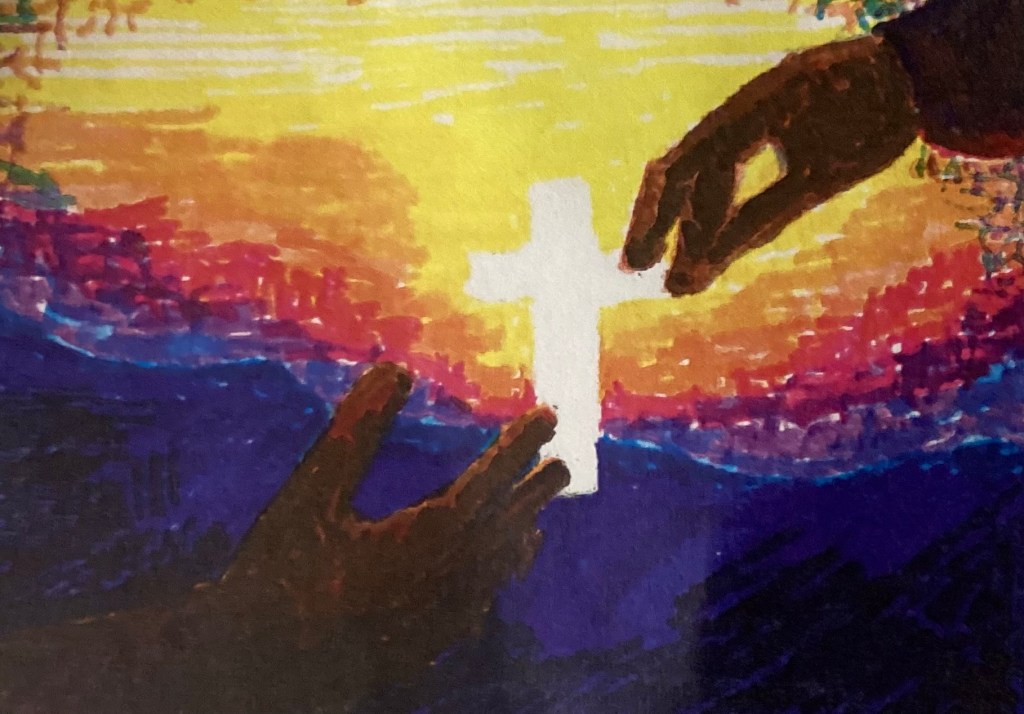
Art work by Jorden Messenbourg.

