It’s a good question. An uncomfortable question, perhaps. Because it’s one thing to say we love God. It’s another thing to look at our calendars, bank statements, and the way we treat the person who is driving 35 miles an hour in the left lane.
Jesus gets at this very question in Matthew 22:15–22. The religious leaders try to trap Jesus with a question about taxes. Should they pay taxes to Caesar or not? If Jesus says yes, he risks upsetting the people who resent Roman rule. If he says no, he risks getting into trouble with the authorities.
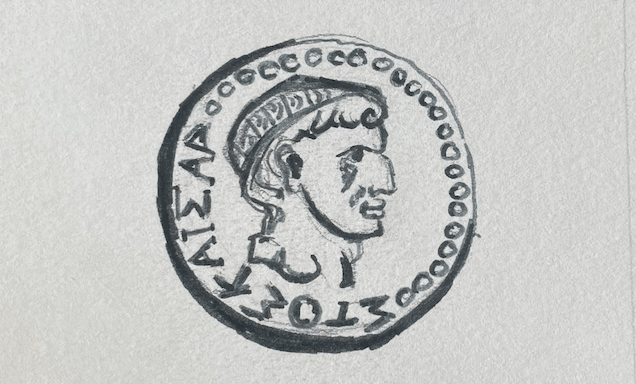
Jesus asks them to show him a coin. Whose image is on it? Caesar’s.
“Give therefore to Caesar the things that are Caesar’s, and to God the things that are God’s.”
Jesus doesn’t give them the easy answer they were looking for. Instead, he invites them to think about what belongs to whom. The coin bears Caesar’s image. But what bears God’s image?
People do.
Which brings me to two stories about names, unexpected kindness, and what our lives reveal about our faith.
April, May, and September
Not long ago, I showed up as the pastor to offer the commendation of the dying for a woman I knew. Her three daughters were there, and I introduced myself. Two of them introduced themselves, too. “April and May,” they said, explaining that they were waiting for their third sister to call.
Naturally, I said, “June?”
They looked at me and said, “No. Her name is September.”
I love a good naming story. And I love the fact that, in the middle of a difficult and sacred moment, there was room for a little humor. Death has a way of stripping away the unnecessary stuff. What matters is being present, loving one another, telling stories, and making room for both tears and laughter.
I was there because I was the pastor. But the work of faith in that room belonged to everyone. It was in the daughters’ presence, their love for their mother, and their willingness to sit together in the hardest of moments.
Faith doesn’t always look like a sermon or a Bible study. Sometimes it looks like showing up.
And Then There Was Toyota
Years ago, while serving as a missionary in Madagascar, I heard a story about a woman in difficult labor who was riding in the back of a truck. The driver realized she needed help and brought her to the hospital. She delivered a healthy baby.
Grateful for the driver’s kindness, she wanted to name her child after him. But by the time she was ready to give him that honor, the driver had already left.
So she named the baby Toyota.
Yes, Toyota.
I’ve always loved this story. Imagine growing up and explaining that your name came from the kindness of a truck driver who got your mother to the hospital in time. It’s an unusual name, but behind it is a beautiful truth: someone’s ordinary act of helping another person became part of a family’s story forever.
The driver probably wasn’t looking for recognition. He was simply doing what needed to be done.
And that is often where faith becomes visible.
Whose Image Do We Carry?
Jesus asks about a coin bearing Caesar’s image. But we are made in the image of God.
If that’s true, then our faith cannot be separated from how we live. It shows up in how we spend our time, whether we notice someone who needs help, how we use our money, and whether we treat people as beloved children of God rather than interruptions to our schedules.
Sometimes faith means being a pastor who shows up for three daughters named April, May, and September.
Sometimes it means being a truck driver who gets a woman in labor to a hospital.
And sometimes it means being the kind of person whose kindness is remembered long after we have driven away.
We may never know the full story of what our actions mean to someone else. We may never know that a simple kindness became a family legend—or that our presence helped someone feel less alone.
But perhaps that’s the point.
We don’t give our lives to God to earn God’s love. We live in response to the love God has already given us. We love because we have first been loved.
So, this week, I’m wondering: If someone looked at my calendar, my bank statement, and the way I treat other people, what would they learn about my faith? Would they see someone who makes room for others? Someone who gives generously? Someone who shows up? And if someone were going to name a baby after me, what story would they tell?
I’m not sure I’m ready for that last question. But I hope the story would have something to do with love.And for the record, I’m grateful the Madagascar story didn’t end with a baby named Pickup Truck.
Art work by Jordan Messenbourg

